How to Choose the Right Perch for a Harris's Hawk
Most of a Harris's hawk's day is spent standing still. On a bow perch in the garden, on a block in the weathering area, on a ring perch in the back of the car — the feet are in constant contact with whatever you have chosen, and the consequences show up slowly. Get the perch right and you will rarely think about it again. Get it wrong and you will be dealing with sore feet, scuffed feathers and a bird that never quite settles.
Start with the foot, not the perch
A raptor's foot is a gripping tool, not a cushion. There is very little soft tissue between the tendons and the skin, which is why prolonged pressure on the underside of the foot causes problems. The classic result is pododermatitis, often called bumblefoot — a swelling or open sore, usually on the sole or the hock. It is painful, slow to heal, and in a working hawk it can put paid to a season.
Two faults cause most of it. A perch that is too thin forces the toes to curl underneath and grip hard all day, so the foot never relaxes. A perch that is too thick gives the bird nothing to hold, so it stands flat-footed with its weight on the sole rather than on the toes. Neither is corrected by padding alone; the diameter has to suit the bird.
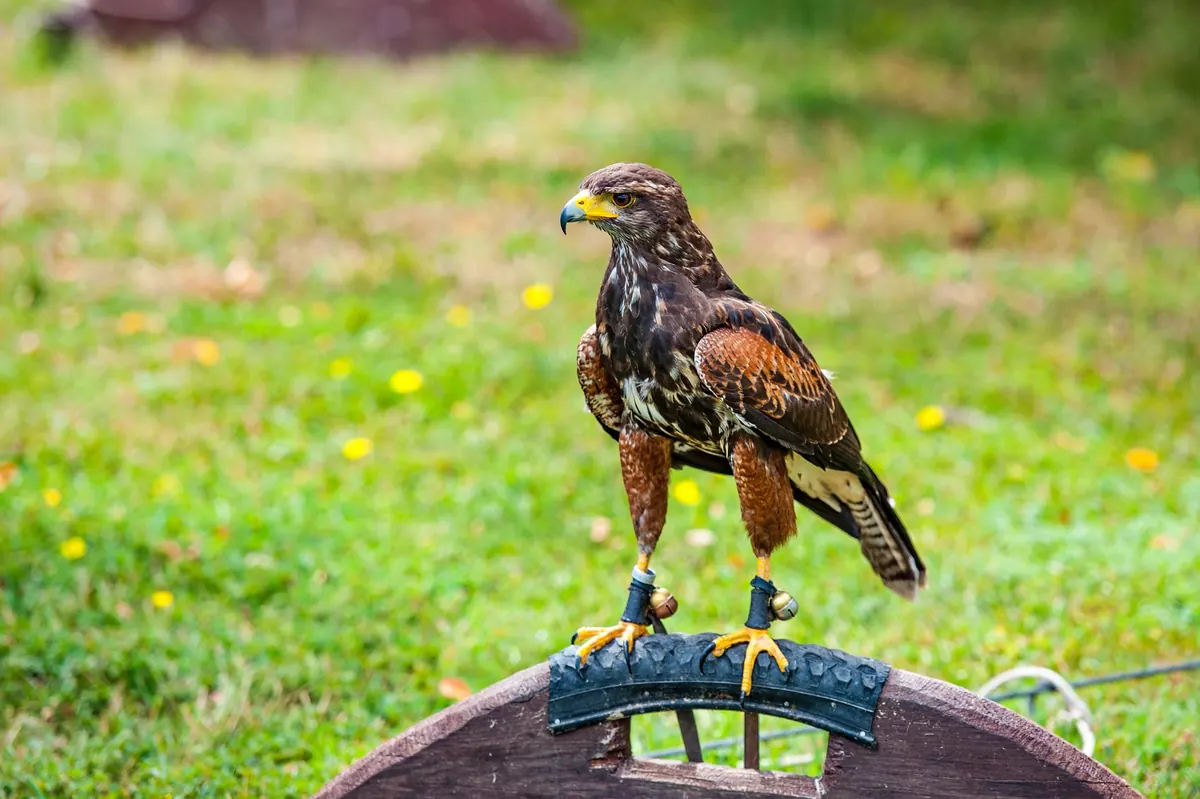
Watch a well-perched hawk and you will see it shuffle, then settle, then lift one foot and tuck it into the chest feathers. That is a comfortable bird. A hawk that shifts constantly, leans forward, or holds its feet flat is telling you something.
Perch types and what each one is good for
Bow perch
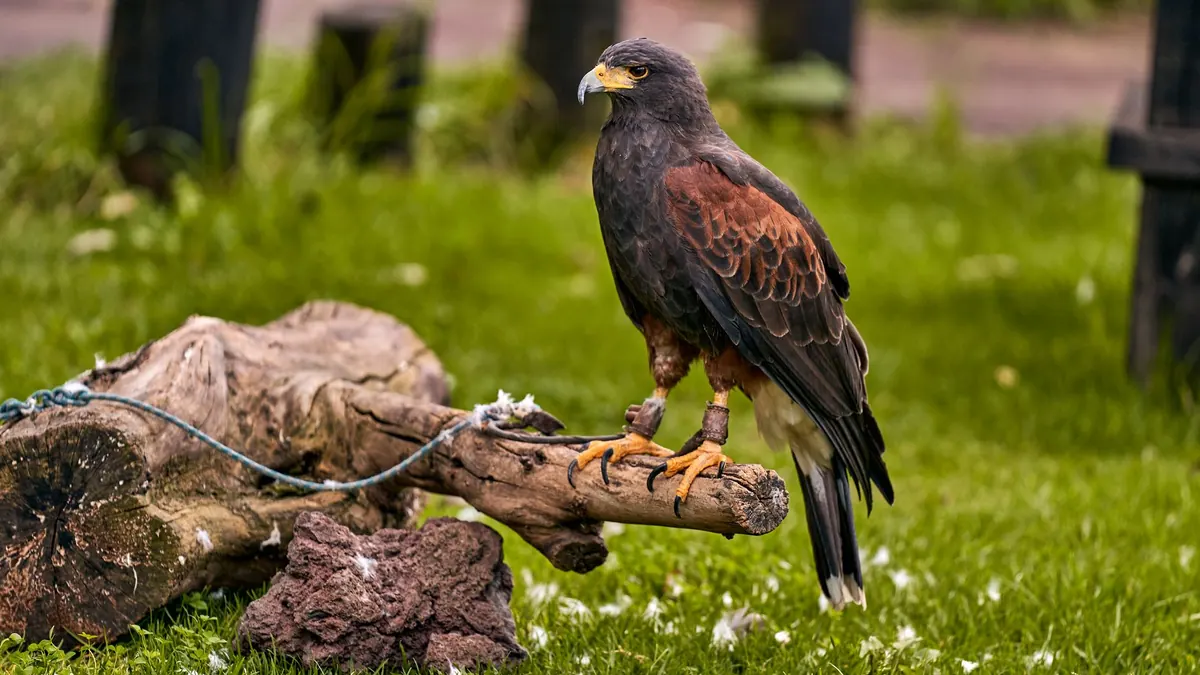
The traditional choice for a Harris's hawk and still the most versatile. A curved bow, usually padded with leather or bound with rope, mounted on a heavy base with a ring or staple at ground level for the leash. The bird sits on the curve; the leash runs down to the ring, which stops it tangling round the legs. Height is low and stable, which suits a broad-winged hawk that would rather step than swing. Excellent for weathering outdoors and for a bird on a tether.
Block perch
A flat-topped block on a post, often with a padded rim and a staple for the leash. Rock solid, good for training, weight management, and any situation where you want the bird calm and still. Many Harris's hawks seem to prefer a wide, flat top for long spells, and a block is easy to keep clean.
Ring or cadge perch
The travelling option. A padded ring or hoop on a short post, with a swivel and a short leash, it fits neatly across a car seat and keeps the bird upright on the move. Never leave a hawk unsupervised on a ring perch for hours at a time; it is designed for transport, not for permanent housing.
Screen perch
A broad, padded rail in a mews or weathering court, giving the bird room to hop along and turn. Useful for long-term housing and for a bird that is moulting or resting. Droppings fall clear of the perch, so the bird stays cleaner and the feet stay drier.
Block-and-ring combinations and free-standing perches
If the hawk comes indoors, a free-standing perch with a washable mat underneath saves a great deal of scrubbing. Whatever you choose, it needs a secure tie point below the bird's feet, never at the level of the head.
Getting the diameter right
For a Harris's hawk, a bow perch measuring roughly 5–7 cm (2–2¾ in) across the curve is a reasonable starting point, with a block top a little wider at around 7–9 cm. Treat those as a starting point, not a rule, because females are noticeably heavier and larger than males and every bird grips differently.
The test takes ten seconds:
- Let the hawk settle on the perch and look at the toes from underneath.
- They should wrap around roughly two-thirds of the perch, with the tips just meeting or slightly over.
- There should be no gap where the foot goes flat, and the toes should not cross or curl back under the palm.
- If the hawk slides, over-grips, or stands with obvious effort, change the size.
Young birds sometimes need a slightly slimmer perch while their grip strengthens, and a bird coming back from a foot injury may need one wider than you would expect. If you are managing an existing foot problem, work with a veterinary surgeon experienced with birds of prey rather than experimenting on your own.
Materials: what to use and what to avoid
Natural cork is forgiving and warm. Rope — sisal or a soft cotton blend — bound tightly round a wooden core gives good grip and can be replaced when it frays. Leather padding on a bow is traditional and works well as long as it is kept dry. Hardwood cores last; softwood does not survive a hawk's grip for long. Neoprene makes a decent, washable cover for block tops and travelling rings.
What to avoid:
- Abrasive or sanded surfaces. Anything rough enough to wear talons quickly is rough enough to damage skin.
- Bare metal, smooth plastic and thin dowel. No grip, no give, and often the wrong diameter.
- Sharp edges, splits and loose staples where a jess or a toe can catch.
- Chain links or wire where the bird actually stands.
- Perches treated with creosote or fresh wood preservative.
- Perches that are too small because they "look right" on a smaller bird.
Remember that a perch is not a substitute for proper talon care. Talons are maintained by coping and filing; a perch coarse enough to do the job in any real sense is one that will hurt the feet.
Position, height and hygiene
Place perches so droppings fall away rather than onto the surface the bird stands on. Keep them out of draughts, but do not shut a hawk away from fresh air and light — a good weatherproof perch gives sun and shade. Height should be comfortable for the handler and safe for the bird: high enough that it feels secure, low enough that a bate does not end in a hard fall against a hard anchor.
Check the tether as carefully as the perch. A leash that is too long risks tangling round the base; too short and the bird cannot move its feet. Jesses and swivels wear at the same points again and again, so inspect them weekly. Scrub wooden and cork perches, wash rope covers, and replace anything frayed rather than re-using it.
A quick weekly routine
- Lift the hawk briefly and look at the soles and the hocks. Any redness, swelling or scab means a perch change and a conversation with your vet.
- Run a hand over the perch. Splinters, splits, compressed rope and caked-on mess all need attention.
- Check the diameter against the foot check above, especially after a moult or a change in weight.
- Inspect jesses, swivel, leash and tie point.
- Rotate between two perches if you can. Varying the surface spreads the pressure and tells you a lot about which one the bird prefers.
Harris's hawks are sociable birds, and if you keep or fly more than one, give each its own perch and tie point with proper spacing. Two hawks sharing one anchor is a recipe for a tangled, panicking mess.
The perch should be boring
The best perch you will ever own is the one you stop noticing. It holds the bird securely, it wipes clean, it does not wear the feet, and nothing on it can catch a jess. Buy the right diameter, choose a surface with a little give, keep it clean, and put the money you save on gadgetry towards a spare perch so you are never caught short when one needs repairing. Your hawk's feet will do the rest of the talking.
Photo: Saeed Khokhar / Pexels
Falconry Gift Guide: Presents for the Falconer in Your Life
A practical falconry gift guide: useful presents at every budget, how to judge leather and metalwork, and...

Flying Weight Explained: Reading Your Bird's Condition Safely
How to find and hold a working bird's flying weight, score condition by hand, and build a daily weighing...
About Us