Jesses, Swivels and Leashes Explained: A Buyer's Guide to Tethering Kit
Tethering kit looks like the simplest part of falconry. Two short leather straps, a small metal swivel, one longer strap. That's it. And yet these few pieces are the difference between a hawk sitting calmly on the fist and a hawk wrapped around a perch with a twisted leg.
Most of the trouble I've seen with tethering kit didn't come from bad luck. It came from a jess that had quietly gone stiff over a winter, a swivel that had stopped turning freely, or a leash bought in a hurry because the old one was fraying. None of those are expensive problems to prevent. They are just easy to overlook until the day they matter.
How the pieces work together
The system is a chain, and each link has one job. The jesses stay on the bird's legs. They meet at the swivel. The swivel joins the jesses to the leash, and the leash is what you hold, tie off or clip to the gauntlet.
That middle part is the bit people underestimate. A bird that bates, turns, or swings on the fist puts rotation into the leash. Without a swivel, that rotation travels straight down to the legs, and leather under tension doesn't stretch — it cuts. The swivel absorbs the twist so the legs never have to.
Because it's a chain, it only holds as well as its weakest part. A beautiful leather leash is no comfort if the swivel rings have worn thin, and a strong stainless swivel is no help if the jess leather is cracked through halfway.
Jesses: the part the bird wears every day
Jesses are the straps fitted around each leg, one per leg. They stay on the bird far longer than anything else in your kit, which is why the leather matters more here than anywhere else. A jess should be supple enough to fold and flex without cracking, and firm enough that it doesn't stretch out of shape after a wet morning in the field.
Traditional jesses and Aylmeri
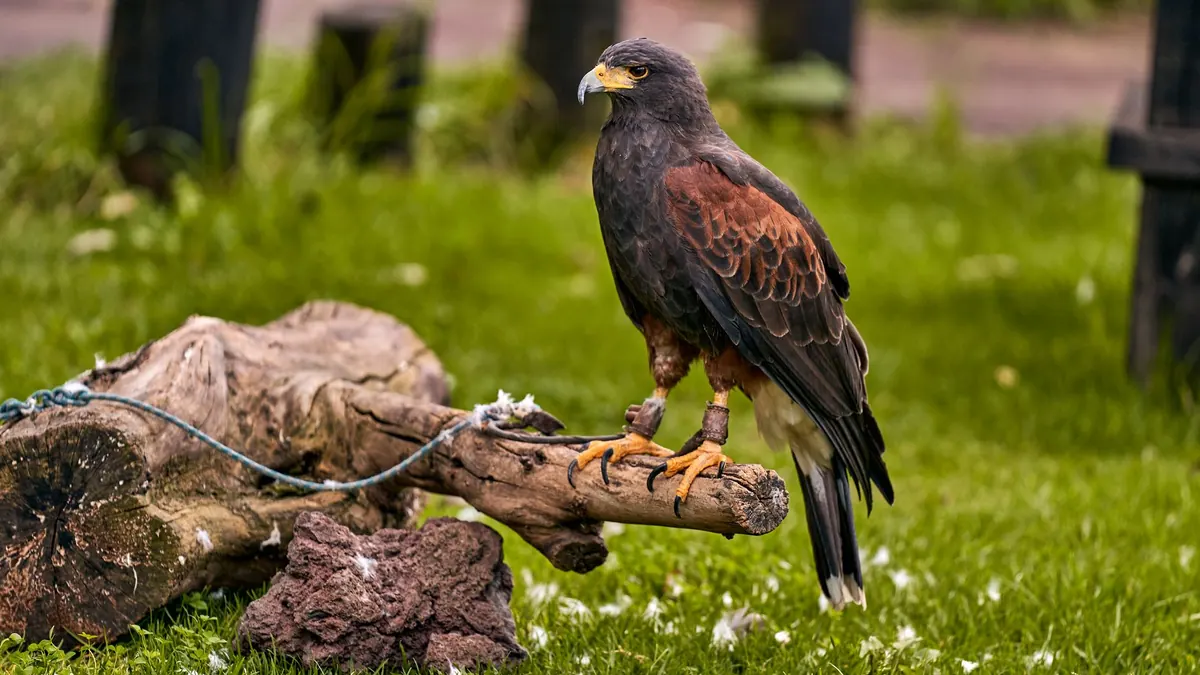
Traditional jesses are single straps that form a loop around the leg by threading through a slit in the strap itself. They're light, simple, and there's nothing to fail except the leather. The trade-off is that fitting and removing them means handling the bird's legs more.
Aylmeri tackle splits the job in two. A slim leather anklet, usually called a bracelet, stays on the leg, and the jess is a separate strap that threads through a metal eyelet in the bracelet. The jess comes off at the end of the day, the bracelet stays put. For a bird you're flying regularly it means less handling, and you can swap a worn jess without disturbing the anklet.
Fit and length
An anklet should be snug enough that it can't slide off over the foot, but loose enough to rotate freely. If you can't turn it a full circle on the leg with light finger pressure, it's too tight.
Jesses should be short. Long jesses are an invitation: the bird grabs them with a foot or a beak, and once a hawk has hold of its own jess you have a wrestling match on your hands. Trim them so there's just enough to reach the swivel and work comfortably, and no more.
Swivels: small, cheap, and the part most likely to let you down
Buy a handful of spares. Swivels are the cheapest item in your bag and the one most likely to fail quietly.
A barrel swivel with a ring at each end is the standard choice: jesses on one ring, leash on the other. Snap swivels add a spring clip on one side, which is handy when you want to move a bird on and off a leash quickly. Ball-bearing swivels turn more freely still, and are worth considering for a bird that twists hard on the creance or on the fist.
Material matters, but so does weight. Brass is traditional, wears well and doesn't corrode badly. Stainless steel is stronger and stays cleaner. What you don't want is a chunky brass swivel on a merlin or a male sparrowhawk — a swivel that's too heavy for the bird pulls on the legs all day. Match the swivel to the bird's size, not to what happens to be in the shop.
Test every swivel before it goes near a bird. Hold one ring, spin the other between finger and thumb. It should turn with almost no resistance, smoothly, with no grinding or catching. Run a fingertip around the inside of each ring and over the gap on any snap. Burrs and sharp edges will saw through leather. A gap that has opened up will let a jess slip out at the worst moment.
Leashes: your side of the connection
The leash is your control line. It's what you hold on the fist, what you tie off when the bird is on the perch or block, and what stops a bad moment becoming a lost bird.
Length is a compromise. Something around a metre and a half suits most everyday handling and field work: long enough to give a little room, short enough that you're not managing coils of leather in one hand while a hawk is bating. A shorter leash is easier indoors and in tight spaces. For longer training flights, a creance is the right tool — a long, light line used for that purpose, not a standard leash stretched to do a job it wasn't made for.
Leather leashes feel best in the hand. They grip, they wear in a way you can read, and braided or flat versions lie quietly without kinking. The trade-off is that leather needs looking after and doesn't enjoy being soaked. Nylon and cord leashes are strong and weatherproof, but they're slippery, they can burn a hand under a sudden load, and they won't warn you the way drying leather will.
Look at how the ends are finished. A hand loop should be properly stitched or spliced, and the knot you use to tie off on a perch should hold firm under load and come free with one pull when you need it. Practise that knot at home, not with a hawk on your fist in the rain.
What to look for in leather and metal
When you're handling kit in a shop or unpacking a delivery, work through this.
- Leather: supple but firm, with a consistent thickness and no thin patches or loose grain.
- Edges: finished and sealed rather than raw and splitting. Rough edges fray and cut.
- Pairs: jesses should match closely in length, width and weight, so the bird isn't pulled to one side.
- Stitching: even, tight, and backstitched at the ends. Tug it gently.
- Swivel action: free, silent, no grinding and no play in the barrel.
- Rings and snaps: fully closed, smooth, no burrs, no sharp gap.
- Metal quality: solid brass or stainless steel. Avoid plated fittings that flake once the plating wears through.
- Weight: proportionate to the bird. Pick it up and picture it hanging from a leg all day.
Fitting, checking and replacing
Make a habit of checking kit while the bird is on the fist. Run each jess between finger and thumb and feel for cracking, dryness or stretching. Spin the swivel. Look at where leather meets metal, because that's where wear starts. It takes thirty seconds.
Leather tells you when it's done. When it feels dry and stiff, when surface cracks appear at the fold, when it has stretched and no longer holds its shape, replace it. Don't wait for it to break. Keep a spare set of jesses and a spare swivel in your bag, and rotate your kit so you notice wear on one set before it becomes a problem.
Size matters as much as condition. Kit sized for a Harris's hawk will swamp a kestrel, and kit sized for a kestrel will be dangerously light on a red-tailed hawk. If a bird has injured a leg, or if a leg looks swollen or rubbed after a session, take the kit off and get proper veterinary advice before you use it again.
A practical buying checklist
- Buy jesses in pairs, plus one spare set in the same size.
- Choose leather weight and jess width to suit the bird, not the shelf.
- Pick two swivels per bird and one spare, in a weight the bird can carry comfortably.
- Get one field leash and one shorter leash for handling and indoors.
- Ask the maker what the leather is, how it was tanned, and how thick it is. A good supplier will answer without hesitating.
- Fit everything and test it before the bird wears it — swivel spin, knot release, jess length.
- Break new leather in gently by hand rather than letting the bird do it.
Buy well once, check it often, and replace it early. That's the whole discipline of tethering kit, and it's the cheapest insurance you'll ever take out on a bird.
Photo: Andrey Matveev / Pexels
Falconry Gift Guide: Presents for the Falconer in Your Life
A practical falconry gift guide: useful presents at every budget, how to judge leather and metalwork, and...

Flying Weight Explained: Reading Your Bird's Condition Safely
How to find and hold a working bird's flying weight, score condition by hand, and build a daily weighing...
About Us